

Ask any five-a-side regular about their groin strain and you’ll usually hear the same story: it happened months, sometimes years ago, it “mostly” settled down, and it flares up again every pre-season without fail. Nobody calls it an ongoing injury. Everybody just calls it “my groin thing.”
That pattern is exactly why adductor strains have a reputation as football’s most under-rehabbed injury. Roughly one in five players who strain a groin muscle will do it again, and a big part of that isn’t bad luck, it’s returning to the pitch once the pain settles rather than once the muscle is actually ready. Managing this properly isn’t a treatment you finish and forget. It’s an ongoing, holistic process, one that looks at strength, movement, workload, and history together, long after the initial pain has gone quiet.
What’s Actually Happening in the Groin
The adductors are a group of muscles running along the inner thigh, responsible for pulling the leg inward during running, cutting, and kicking. A strain happens when these muscles are asked to lengthen and contract at the same time, under load, faster than they’re conditioned to handle, classically during a sharp change of direction, a hard tackle, or a mistimed kick.
This eccentric loading, the muscle working while it stretches, is exactly why groin strains show up so often in football specifically. Sprinting, cutting, and kicking all demand it repeatedly, and a muscle that hasn’t been trained to absorb that kind of load is the one that tears.
Why It’s So Often Under-Rehabbed
Most muscle strains have an obvious marker of recovery: the pain goes. Groin strains are trickier, because the pain often settles well before the muscle has regained the strength and control it needs for a hard change of direction. Players, and sometimes coaches, read “pain-free jogging” as “ready,” when the far more relevant question is whether the muscle can absorb a sudden eccentric load without failing.
This gap between feeling fine and being genuinely ready is where reinjury creeps in. It’s a similar story to a lot of the misconceptions around physiotherapy more broadly: the assumption that once something stops hurting, the job is done.
Why It Happens: The Real Risk Factors
A handful of factors show up again and again in the research on who ends up with a groin strain.
A Previous Groin Injury
This is, by a wide margin, the strongest predictor. Players with a history of groin strain are over twice as likely to sustain another one, largely because the muscle was returned to play before it fully regained its strength and capacity.
Adductor Strength and Imbalance
Weak adductors, particularly relative to the abductor muscles on the outside of the hip, are consistently linked to higher injury risk. This imbalance is often invisible day to day and only shows up under the specific load of a hard cut or tackle, and it’s part of why groin problems and back pain so often turn up in the same players.
Low Pre-Season Conditioning
Players who go into a competitive season under-conditioned, especially after an off-season with little sport-specific loading, carry meaningfully higher risk. The muscle simply hasn’t been prepared for the demands about to be placed on it.
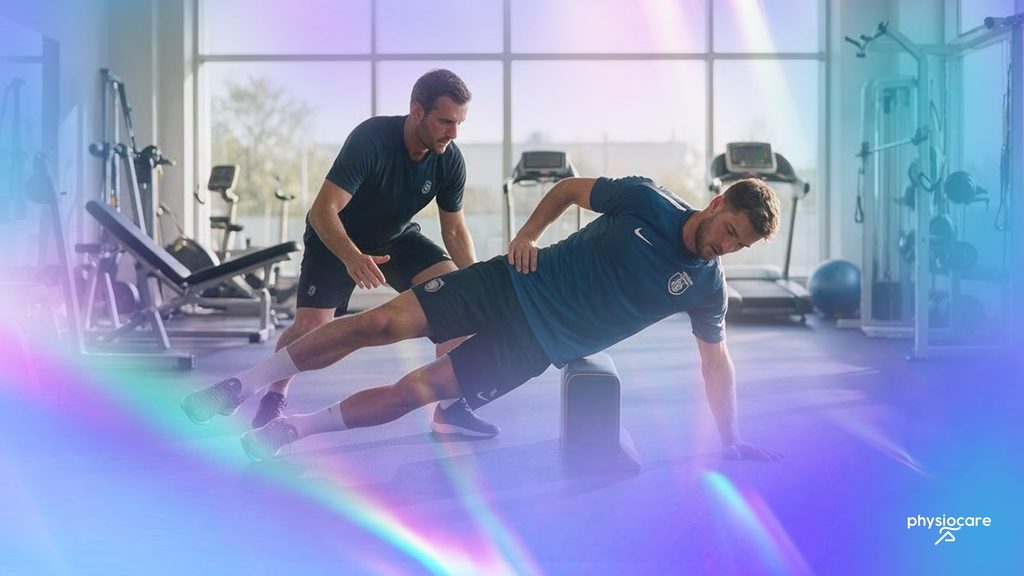
Rehab That Actually Works: A Staged Return
Proper adductor rehabilitation moves through distinct stages, and skipping ahead is exactly how the one-in-five reinjury statistic keeps happening.
Calm It Down, Carefully
Early on, the focus is pain-free range of motion and gentle activation, not aggressive stretching or early strength work. Pushing too hard here tends to backfire.
Rebuild Real Strength
As tolerance improves, progressive strengthening takes over, often including isometric and eccentric adductor work. This phase is about rebuilding genuine capacity, not just getting the muscle to stop complaining.
Prove It Under Load
The final stage tests the muscle the way a match will: cutting, accelerating, decelerating, and kicking at increasing intensity. Return to play should be based on objective markers, strength testing, movement quality, and performance under simulated match conditions, not simply how many weeks have passed since the injury.
Supportive tools like sports massage and recovery-focused therapies can help manage tightness and support the process throughout, but they work alongside a structured strength programme, not instead of one.
Managing It, Not Just Treating It
A groin strain that keeps recurring isn’t a sign of bad luck or a fragile body. More often, it’s a sign that the muscle was managed as a one-off problem rather than an ongoing part of a player’s training picture, previous injury history and conditioning included. That whole-picture view is exactly how we work with footballers at Physiocare.
If your groin has been “mostly fine” for a while now, that’s worth a proper look before next pre-season catches you out again. Get in touch with our team, and let’s build a plan around the whole picture, not just the last time it hurt.